


Can we truly trust the grand narratives that claim to explain the entirety of human experience? Jean-François Lyotard’s seminal work, The Postmodern Condition, challenges us to adopt a stance of incredulity toward such overarching stories. But what if this skepticism is not just a philosophical position but a playful provocation to rethink how we understand knowledge, power, and truth? Let’s explore 10 quotes from Lyotard’s text that encapsulate his critique of metanarratives and invite us to question the certainties we often take for granted.
The Skepticism of the Postmodern Mind
At the heart of Lyotard’s thought is an attitude of incredulity—not cynicism, but a questioning skepticism—toward metanarratives. These grand stories, whether political, scientific, or economic, claim ultimate legitimacy. Lyotard prompts us to ask: Are these narratives truly universal, or do they mask smaller, competing narratives we tend to overlook?
Fragmentation Overrides Unification

Lyotard argues that in the postmodern era, the totalizing claims of metanarratives wane, giving way to a fragmented landscape of localized “language games.” This perspective challenges the idea that a single story or ideology can consolidate knowledge or identity—a playful nudge toward embracing complexity instead of simplification.
Questioning the Legitimacy of Universals

By doubting the universality of grand narratives, Lyotard questions the legitimacy of supposedly neutral, objective knowledge. What does it mean to legitimize knowledge claims? He pushes us to see every claim as embedded in particular social and historical contexts, thus challenging entrenched power dynamics disguised by universal truths.
Simplifying to the Extreme
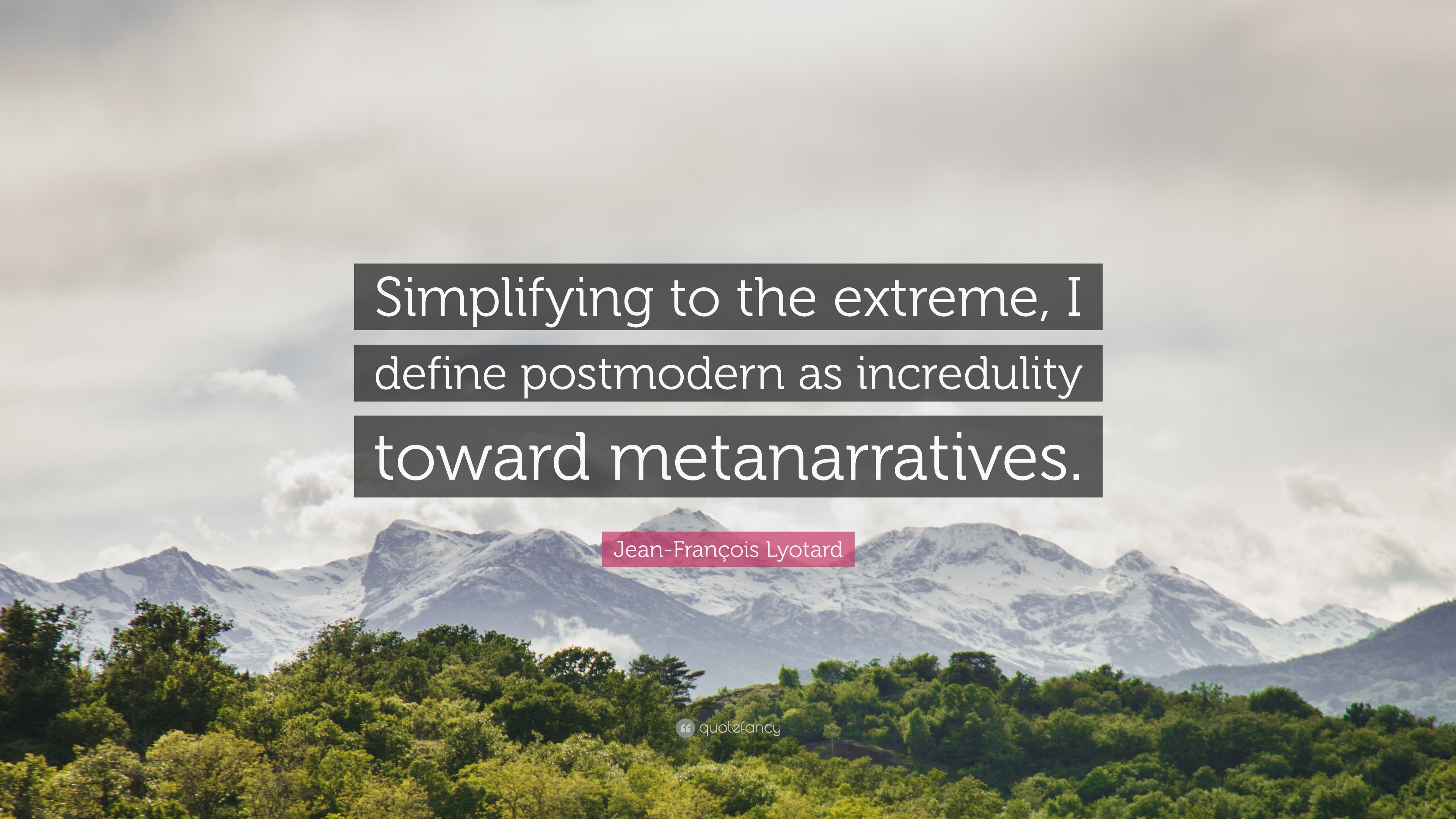
“Simplifying to the extreme, I define postmodernism as incredulity toward metanarratives.” With this pithy phrase, Lyotard playfully captures the essence of his philosophical stance. Instead of seeking a simplified grand truth, he invites us to revel in the multiplicity of stories and the resistance to closure.
Is Knowledge a Game?
Lyotard calls attention to “language games,” the idea that knowledge systems function like rule-bound games without any overarching referee. Does this mean knowledge is arbitrary, or does it mean that skepticism keeps us alert to the conditions under which knowledge is produced and validated?
Incredulity as Wisdom

Incredulity may sometimes be dismissed as ignorance or folly, yet Lyotard reframes it as a form of wisdom. By refusing to accept totalizing stories blindly, the postmodern thinker unveils multiple perspectives and resists complacency.
Power and Knowledge Intertwined
Lyotard reveals how power relations are embedded in metanarratives, with dominant stories legitimizing certain interests while suppressing others. Isn’t the challenge then to recognize and resist this conflation, to allow marginalized language games to emerge?
Multiplicity Over Monolith
Rather than a monolithic truth, Lyotard champions a multiplicity of micro-narratives, each valid within its own context. Could this plurality be a source of creativity and democratic engagement rather than fragmentation and chaos?
Does Postmodernism Freeze or Liberate?
One might wonder if this incredulity leads to paralysis—unable to commit to any truth—or if it instead opens freedom by dissolving oppressive universals. Could the playful skepticism Lyotard promotes become a tool of liberation?
Embracing the Uncertain Future
Finally, Lyotard’s challenge to metanarratives is not simply destruction but an invitation to experiment with new forms of knowledge. Would embracing incredulity enable new ways of thinking that accommodate difference and complexity in an increasingly fragmented world?
