


What if God and nature were not two separate entities, but one and the same? Baruch Spinoza, the 17th-century Dutch philosopher, dared to ask this very question, challenging centuries of religious dogma with his radical ideas. His philosophy, often called “Spinozism,” suggests that God is not a transcendent being but the very essence of the universe itself—nature in its purest form. This idea, both profound and controversial, reshaped how we think about existence, freedom, and the divine. Let’s explore 10 of Spinoza’s most thought-provoking quotes about God and nature, each a window into his unique worldview.
God as the Infinite Substance

Spinoza famously argued that God is not a being with a personality but the infinite substance from which everything flows. In his view, God is not separate from the world but the very fabric of reality. This idea flips traditional theism on its head—imagine a universe where divinity isn’t an external force but the energy that binds all things together. It’s a humbling thought: we are not separate from God; we are expressions of God.
Nature’s Indifference to Human Desires
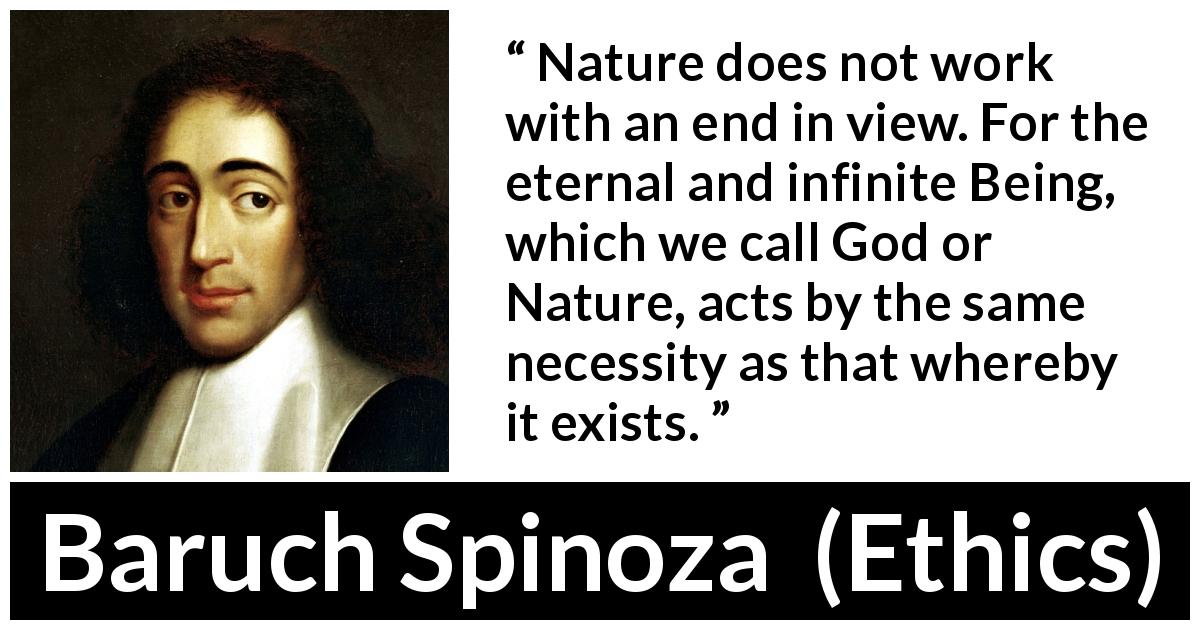
“Nature does not work with an end in view,” Spinoza declared, rejecting the idea that the universe exists for human benefit. This quote cuts to the core of his philosophy: nature operates according to its own laws, not to fulfill our desires or moral expectations. It’s a stark reminder that the cosmos doesn’t revolve around us—we’re just one small part of a vast, indifferent system. How’s that for humility?
The Triangle’s Silent Wisdom

Spinoza’s playful yet profound thought experiment about a triangle “speaking” reveals his belief in the inherent order of nature. If a triangle could articulate its essence, it would describe the unchanging laws that define its shape—just as nature operates through immutable laws. This quote underscores his view that everything in existence follows a predetermined structure, from geometric shapes to the stars. The universe, in Spinoza’s eyes, is a grand, self-sustaining machine.
God’s Indwelling Presence

Here, Spinoza dismantles the idea of a distant, interventionist God. Instead, he posits that God is “indwelling”—present within every aspect of existence, not as a separate entity but as the life force animating all things. This challenges the notion of a God who occasionally intervenes in human affairs. For Spinoza, divinity isn’t a puppeteer; it’s the very breath of life itself.
The Highest Felicity: Love of God
Spinoza believed that true happiness comes from understanding and loving God—or, more accurately, understanding and loving the universe as it truly is. This isn’t a sentimental love but a rational, intellectual embrace of nature’s necessity. To love God, in Spinoza’s terms, is to see the world clearly, without illusion, and to find peace in its inevitable flow. It’s a radical take on spirituality—one that prioritizes knowledge over blind faith.
Freedom Through Understanding

Spinoza’s philosophy is often misunderstood as fatalistic, but he argued that freedom comes from understanding nature’s laws. By comprehending the causes behind our actions and the universe’s workings, we can align ourselves with necessity rather than fighting against it. It’s a call to embrace reality, not as a series of random events, but as a coherent, interconnected whole. True freedom, for Spinoza, isn’t the absence of constraints—it’s the mastery of them.
The Illusion of Separation
One of Spinoza’s most radical ideas is that the distinction between God and nature is an illusion. We often think of them as separate—God as the creator, nature as the creation—but Spinoza saw them as two sides of the same coin. This blurring of boundaries forces us to reconsider our place in the universe. Are we separate from nature, or are we nature itself, just in a more complex form?
The Power of Reason
For Spinoza, reason is the key to unlocking the mysteries of God and nature. By using logic and observation, we can peel back the layers of illusion that cloud our understanding. This faith in human intellect was revolutionary—it suggested that we don’t need divine revelation to grasp the truth. Instead, the truth is accessible to anyone willing to think deeply and critically. It’s a challenge to dogma and a celebration of human potential.
The Eternal Now
Spinoza’s concept of eternity isn’t about endless time but about the timeless nature of reality. In his view, God—or nature—exists outside of time, in a perpetual “now.” This idea suggests that past, present, and future are all equally real, and our perception of time is merely a limitation of human consciousness. It’s a mind-bending perspective that invites us to see the universe as a single, unchanging whole.
The Challenge of Spinozism
Spinoza’s ideas were so radical that he was excommunicated from his Jewish community and condemned by both religious and philosophical authorities. Yet, his philosophy endures because it offers a compelling alternative to traditional theism. It asks us to see the world not as a place of divine mystery but as a rational, interconnected system. Whether you agree with him or not, Spinoza’s challenge to think differently about God and nature is one that still resonates today.
