Sergei Eisenstein, the legendary Soviet filmmaker and theorist, left behind a legacy that transcends cinema. His revolutionary ideas about montage, conflict, and visual storytelling continue to inspire artists, filmmakers, and thinkers across disciplines. Eisenstein’s words are not just theoretical—they are vivid metaphors that paint pictures in the mind, blending artistry with raw intellectual power. Below are 10 quotes that capture the essence of his genius, each a testament to his ability to transform abstract concepts into striking visual and emotional experiences.
The Power of Conflict in Art
Eisenstein believed that conflict was the heartbeat of all art. In his view, the collision of opposing forces—whether in a single frame or across a narrative—creates tension, depth, and meaning. This idea wasn’t just about drama; it was a fundamental principle of how art evolves. By embracing conflict, artists could unlock new dimensions of expression, turning even the simplest scenes into powerful, thought-provoking experiences. His words remind us that beauty often emerges from struggle, and that tension is not something to shy away from, but to harness.
Cinema as a Mirror of Human Emotion
For Eisenstein, art was not merely a reflection of reality but a tool to expose the invisible layers of human experience. He saw cinema as a way to make the intangible visible—whether it was the unspoken tension between characters or the raw, unfiltered emotions lurking beneath the surface. His approach was not about realism in the traditional sense but about distilling truth into its most potent visual form. This idea challenges artists to look beyond the surface, to find the poetry in the unseen, and to use their craft to reveal what words often cannot.
The Director’s Sacred Duty

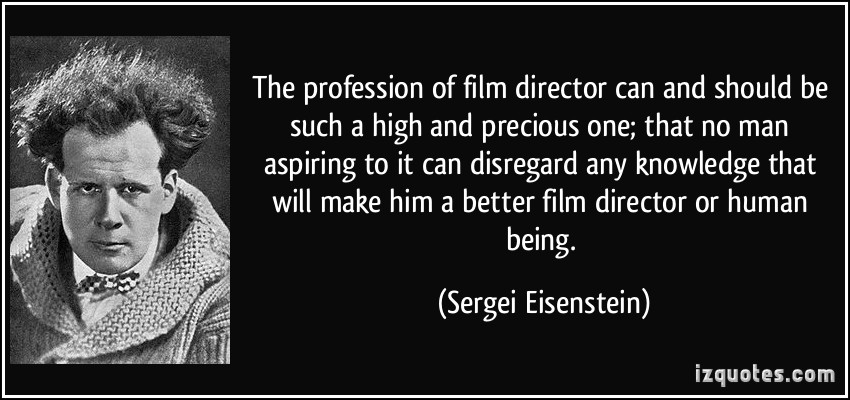
Eisenstein held the role of the director in the highest regard, seeing it as a calling rather than just a profession. He believed that a true director had a responsibility to push boundaries, to elevate cinema beyond mere entertainment, and to infuse every frame with purpose. This wasn’t about ego or control but about serving something greater—the art itself. His words echo a timeless truth: great art requires sacrifice, dedication, and an unwavering commitment to excellence. For those who wield the camera, this is both a challenge and an invitation.
Montage as a Revolutionary Tool
Eisenstein’s theory of montage was nothing short of revolutionary. He saw it as a way to create meaning not just through individual shots but through their collision. By juxtaposing images in unexpected ways, he believed artists could evoke emotions and ideas that no single frame could convey alone. This concept transformed filmmaking from a linear narrative into a dynamic, intellectual experience. His words remind us that sometimes, the most powerful stories are not told in a straight line but in the spaces between the lines—where meaning is born from contrast and surprise.
The Invisible Becomes Visible
Art, in Eisenstein’s eyes, was a bridge between the visible and the invisible. He believed that the artist’s job was to make the unseen tangible—to take abstract concepts like time, memory, or emotion and render them in a form that could be felt. This idea is particularly resonant in film, where a single image can evoke an entire lifetime of experiences. His words challenge artists to see beyond the obvious, to find the extraordinary in the ordinary, and to use their craft to illuminate the hidden truths of the human condition.
The Language of Images
Eisenstein often spoke of cinema as a language, one that could communicate ideas and emotions without relying on dialogue. He believed that images could convey meaning in ways that words never could—through rhythm, composition, and juxtaposition. This idea was radical at the time, challenging the dominance of verbal storytelling in art. His words inspire artists to think of their work as a form of communication, one that speaks directly to the soul without the need for explanation. In a world saturated with noise, his vision reminds us of the quiet power of visual language.
The Art of the Unexpected
For Eisenstein, the unexpected was not just a tool but a necessity. He believed that true art should disrupt, challenge, and surprise—never settling for the familiar or the safe. Whether through abrupt cuts, unconventional framing, or bold thematic choices, he saw disruption as a way to jolt the audience into new ways of seeing. His words are a call to artists to embrace the unfamiliar, to take risks, and to trust that the most groundbreaking ideas often come from the least expected places.
The Soul of the Artist
Eisenstein viewed the artist as a kind of alchemist, capable of transforming raw materials—whether paint, film, or words—into something transcendent. He believed that great art was not just about skill but about the artist’s ability to channel something deeper, something almost spiritual. This idea elevates the act of creation from a technical exercise to a sacred act. His words remind us that art is not just about what we create but about who we are in the process—our struggles, our passions, and our unyielding pursuit of truth.
The Revolution of Perception
Eisenstein saw art as a force for revolution—not just in politics but in perception. He believed that artists had the power to change how people see the world, to challenge their assumptions, and to open their eyes to new possibilities. This was not about propaganda but about awakening. His words are a rallying cry for artists to use their craft as a tool for transformation, to push boundaries, and to inspire others to see the world with fresh eyes. In an era of conformity, his vision remains a powerful reminder of art’s potential to ignite change.
The Legacy of Visual Storytelling
Eisenstein’s ideas about visual storytelling have left an indelible mark on culture, influencing generations of filmmakers, artists, and thinkers. His belief in the power of images to convey meaning, evoke emotion, and challenge perception remains as relevant today as it was in his time. His words are a testament to the enduring magic of art—a reminder that the most revolutionary ideas are often the ones that can be seen, felt, and experienced long before they are fully understood. For those who dare to create, his legacy is both a challenge and an inspiration.